When Vietnam officially allowed lecturers and scientists at public universities to establish or operate enterprises to commercialize their research results, it marked a major policy breakthrough in science and technology development. Yet, to truly unleash innovation within academia, a single decree is not enough. What’s needed is a shift in mindset — and an ecosystem that transforms knowledge into value.
In Canada, this journey has unfolded over four decades. From the experiences of innovation hubs like Queen’s University and the University of Waterloo, Vietnam can draw several powerful lessons.
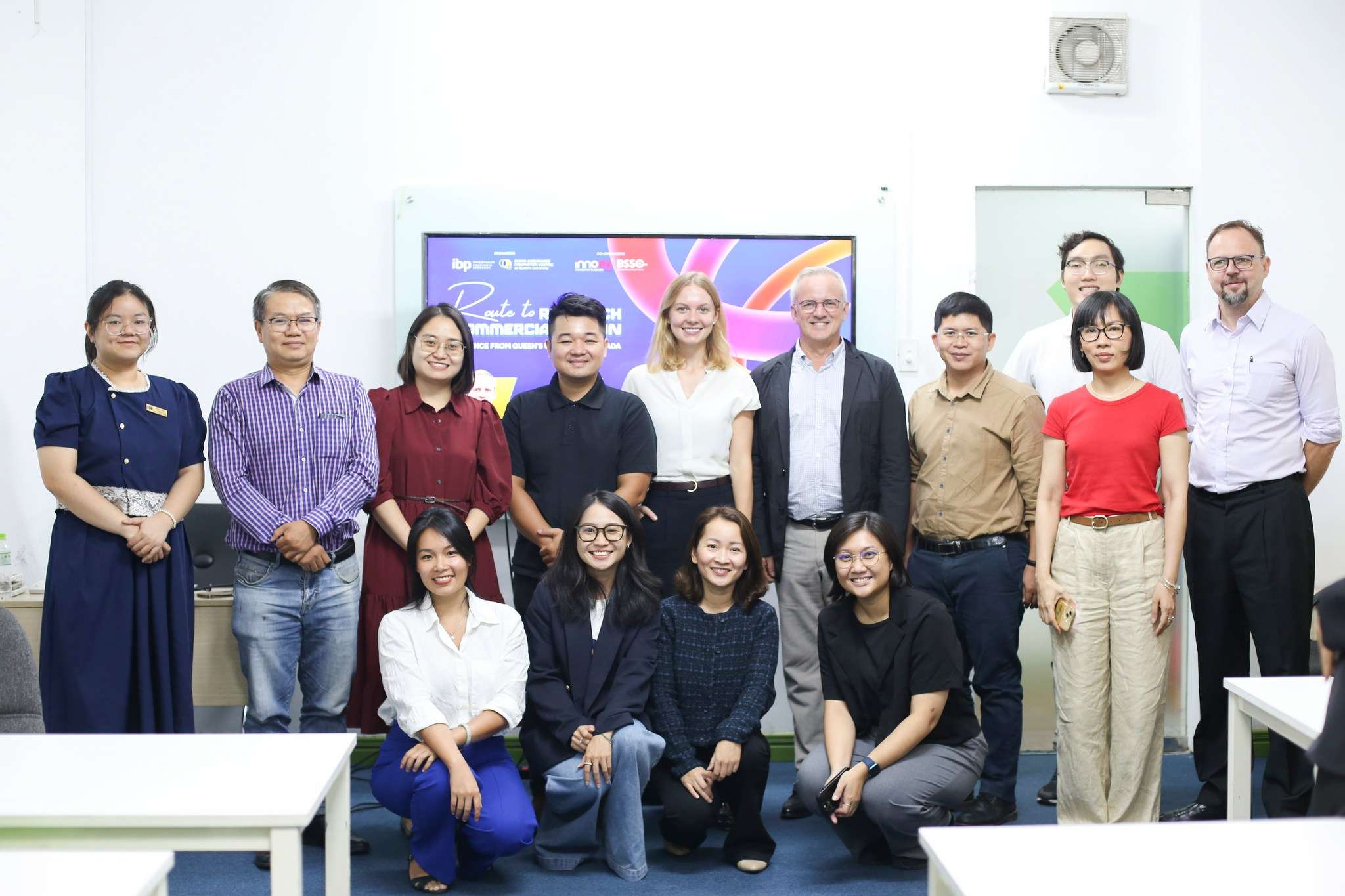
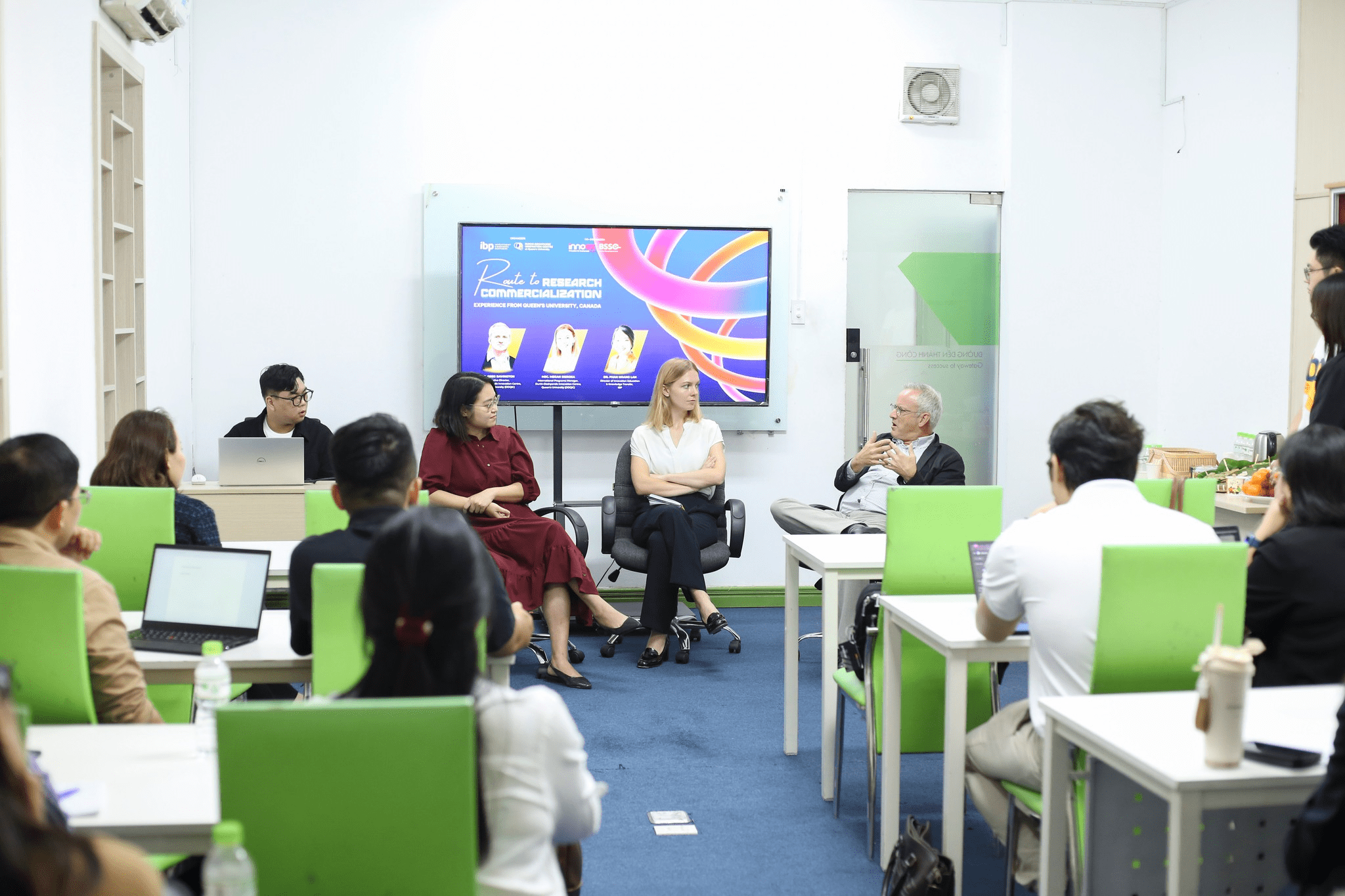
The workshop titled “Route to Research Commercialization: Experience from Queen’s University (Canada)”, jointly organized by IBP and BSSC, featured experts from the Dunin-Deshpande Queen’s Innovation Centre (DDQIC). The session offered a practical and insightful perspective on how Canadian universities transform research into social impact and economic value.
Intellectual Property Ownership: The Root of Commercial Thinking
In Canada, although most universities are publicly funded, they enjoy significant autonomy in research, teaching, and intellectual property (IP) management.
There are two main models:
-
Institutional Ownership: The university owns all inventions by its researchers. If commercialized, profits are shared with the inventors.
-
Inventor Ownership: Researchers fully own their research outcomes.
A standout example is the University of Waterloo, where inventors retain 100% IP ownership. This policy has turned Waterloo into a cradle for hundreds of spin-off companies – including the once-iconic BlackBerry.
At Queen’s University, a more flexible approach prevails: researchers can choose to commercialize through the university or independently. The university acts as a facilitator, not a gatekeeper.
As Professor Greg Bavington, Executive Director of the Dunin-Deshpande Queen’s Innovation Centre (DDQIC), shared:
“When researchers feel trusted and empowered, they’re far more motivated to bring their inventions to the world.”
Innovation Centers: Bridging the Classroom and the Marketplace
When people think of innovation at universities, they often imagine laboratories or research funds. In Canada, however, innovation centers play a crucial bridging role – connecting academic ideas with real-world business needs.
At the Dunin-Deshpande Queen’s Innovation Centre (DDQIC), programs are designed to help students and faculty turn research into tangible products. QIC runs entrepreneurship bootcamps, startup competitions, mentorship networks, and interdisciplinary incubator programs that unite engineers, scientists, and business students around shared challenges.
A prime example is Spectra Plasmonics, a startup founded by chemistry students who developed a handheld analyzer to detect toxins in food and drugs. Within just 13 weeks of incubation at QIC, they moved from lab concept to commercial success.
As the founders shared, their biggest breakthrough wasn’t funding or technology – it was early, honest conversations with businesses to understand real market pain points.

The Core Principle: Innovation Starts with Mindset, Not Technology
Professor Greg Bavington remarked:
“Most research collaboration contracts end up in a drawer after signing until something goes wrong.”
This captures a key reality: many university–industry partnerships fail not because of technical issues, but because of misaligned goals and incentives.
Academics seek publications; companies seek market advantage. Without early alignment on rewards, expectations, and value, collaboration collapses quickly.
That’s why “alignment” is the keyword. At Queen’s, alignment workshops are held regularly, bringing academics and businesses together to openly discuss objectives, risks, and mutual benefits. Only when there’s understanding can true collaboration thrive.
From “Commercialization” to “Impact”: Redefining Value
At many Canadian universities, a researcher’s success isn’t measured by profit – but by social impact.
As the Executive Director of the Queen’s Innovation Centre explains:
“We define value as anything that delivers greater benefit to society than the cost of creating it. That could mean better healthcare systems, smarter policy, or cleaner manufacturing – not just revenue.”
Hence, innovation programs adopt a “theory of change” framework to assess impact, alongside a cost-price-value model ensuring that every project generates net positive value for society – regardless of commercial outcomes.
Some programs even track changes in mindset and skillset, not just patents or startups. This approach sustains both academic integrity and societal relevance, fostering ethical and sustainable innovation.
Building Trust Through Small Wins
Dr. Phan Hoang Lan (Director of Innovation Education & Knowledge Transfer, IBP) once recalled a Vietnam-Finland collaboration in 2012 aimed at research commercialization. Of over 30 promising research outcomes identified, only three reached business agreements and just one reached the pilot phase.
The obstacle wasn’t technology. It was trust. Businesses were unfamiliar with working with universities; universities lacked people who understood markets. The only way forward was through small, shared victories.
For instance, one local juice company sought help from a university lab to solve a small but tricky problem: how to make fruit pieces float inside a bottle.
The project cost only about USD 10,000, but its success created a “trust story” – a symbol of what collaboration could achieve.
That story then inspired deeper partnerships to follow.
Lessons for Vietnam: Build Bridges, Not Walls
Canadian experts often refer to the gap between universities and businesses as a “third space” – a zone that’s neither purely academic nor purely commercial.
In this space, intermediary organizations – research funds, applied institutes, innovation hubs – act as translators between two worlds. They help businesses understand science, and scientists understand markets.
Organizations such as the Canadian Cancer Society or Cystic Fibrosis Foundation exemplify this model: conducting purpose-driven research while maintaining academic ethics and focusing on measurable impact.
This hybrid mindset – blending scholarship with practicality – is the foundation of Canada’s long-term innovation success.
Canada has shown that when guided properly, knowledge itself can become a true source of economic growth. Its strongest commercialization sectors – from healthcare and clean energy to AI and climate tech – all began in universities.
For Vietnam, that offers an inspiring vision: a future where universities don’t just produce talent – they produce enterprises.