

Innovation is the key for businesses to break through and achieve strong growth. However, not every company has sufficient capabilities to innovate on their own due to limitations in scale, resources, institutions, and internal culture. Instead of developing everything in-house, businesses are increasingly collaborating with technology partners, research institutes, startups, and innovation experts to co-create new ideas and innovative models. As a result, open innovation has become a dominant approach, helping enterprises shorten experimentation time, reduce costs, and accelerate the speed of value creation.
What is Open Innovation?
Open Innovation is a management model that enables companies to innovate and accelerate growth by collaborating with external individuals and organizations. It represents a major cultural shift from closed, secretive R&D practices toward openness and shared innovation responsibility.
Open innovation typically operates through three mechanisms:
- Outside-in innovation: Businesses source creative ideas and technology from external partners such as startups, incubators, or research organizations.
- Inside-out innovation: Internal ideas are commercialized through external partners when aligned with specific customer needs.
- Coupled innovation: Co-development of technology or solutions between companies (e.g., joint R&D programs).
In any approach, an open innovation ecosystem involves two main groups with distinct roles:
- Internal R&D teams: Identify business problems, explore new solutions, evaluate external technologies, and propose investment opportunities for implementation.
- External innovation resources: A global network of scientists, entrepreneurs, universities, accelerators, and research institutes providing diverse, breakthrough solutions across industries.

Case Study: Samsung and the Power of Open Innovation
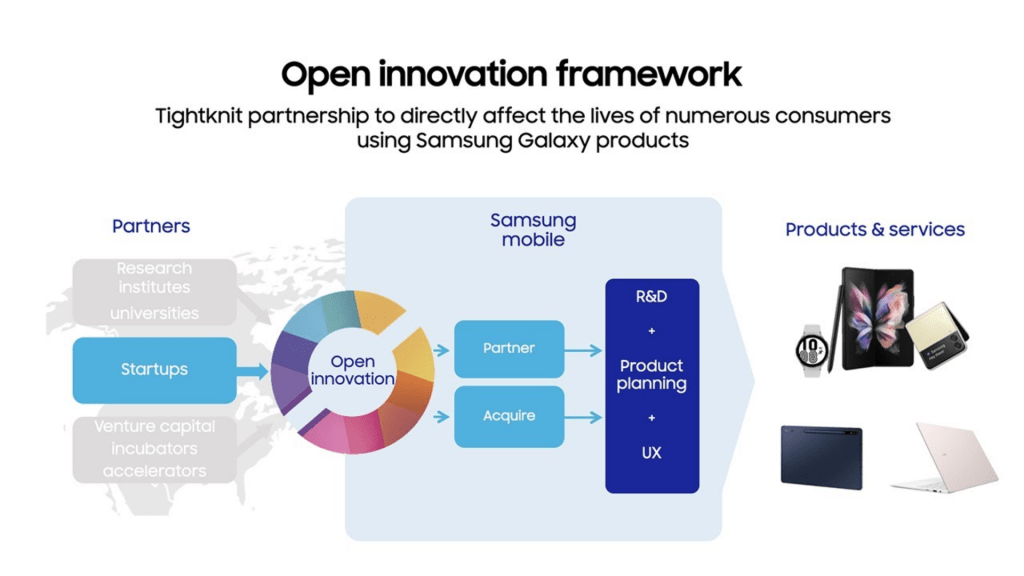
Samsung is one of the world’s most successful open innovation pioneers. The company not only invests massively in internal R&D but also develops extensive collaboration programs, especially with startups.
Samsung runs two parallel strategies:
- Closed Innovation: Reinforcing its strong internal R&D capabilities.
- Open Innovation: Partnering with startups, universities, developers, and technology suppliers.
As a leading Korean chaebol, Samsung has long operated with a highly internal-focused innovation culture. With more than 40,000 R&D engineers worldwide, Samsung dominates the entire value chain — from hardware to software and user experience.
However, internal strengths alone are not enough. To maintain its leadership and expand its ecosystem, Samsung strategically leverages external innovation from diverse communities.
1. Samsung Information Systems America (SISA)
A core R&D hub enabling open innovation. Founded in 1988 in San Jose, California, SISA focuses on advanced technology research and core innovation development to enhance Samsung’s global competitiveness.
Key open innovation activities include:
- University Relations – joint research, funding, and technology co-development
- Startup & Entrepreneur Collaboration – partnerships on emerging technologies
- IP & Licensing – buying, licensing, and transferring technologies to accelerate adoption
- Industry Collaboration – co-innovation with global business partners
2. SK Telecom & Samsung Electronics – Open Innovation Center (OIC)
A collaboration initiative aimed at expanding Android’s ecosystem in Korea.
Notable activities:
- Android Application Development Festival: 90 developer teams competing for KRW 325M in prizes
- Collaboration with Google to support Android developer communities
- SK Telecom was the first Korean carrier to introduce Android phones — paving the way for OIC’s significant impact.
The Core Lesson: Innovation Should not Be Done Alone
Even industry giants cannot innovate in isolation.
Samsung’s success lies in the strategic combination of strong internal capabilities and external collaboration — a formula for sustainable innovation rather than short-lived initiatives
Meanwhile, unlike Samsung, many Vietnamese companies face limitations in capital, R&D workforce, technology adoption, and innovation management. Therefore, open innovation is not an optional strategy — it is the most efficient pathway forward.
Businesses do not need to:
- Spend years developing solutions they can co-create in months
- Struggle with emerging tech when startups already master it
- Carry 100% of innovation risks alone
Open innovation helps companies shorten the journey, reduce failure, accelerate testing, and empower bold ideas. Crucially, open innovation is not just about technology — it is a mindset of leveraging external knowledge to create internal value.

Where Should Businesses Begin? A 5-Step Open Innovation Kickstart
1. Define core innovation priorities: Which areas need transformation: product, process, supply chain, marketing, or operations?
2. Identify the right external partners: Universities, startups, technology vendors, and experts serve as powerful innovation catalysts.
3. Design collaboration formats
✔ Innovation challenges
✔ Co-creation projects
✔ Joint R&D partnerships
✔ Licensing / Technology acquisition
4. Create a sandbox for rapid experimentation: Test fast – fail fast – learn fast – scale fast.
5. Measure outcomes and scale successes: Innovation should become an operating system, not a one-off campaign.
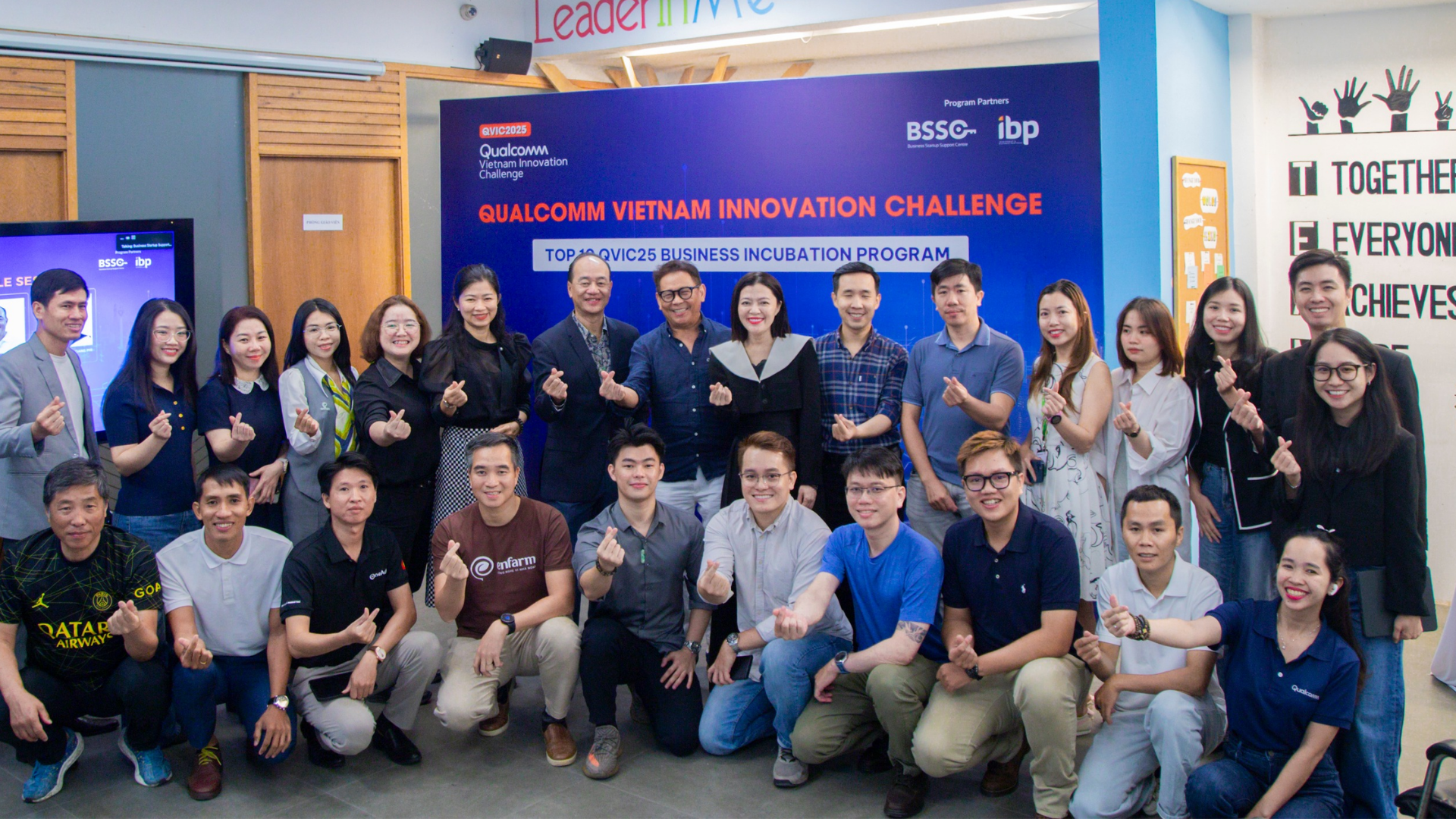
IBP: Empowering Vietnam’s Enterprise Innovation Transformation
With 15 years of hands-on experience enabling corporate and institutional innovation, IBP is the strategic partner that helps Vietnamese businesses accelerate transformation with lower risk.
Through an established ecosystem of:
- Experts & innovation consultants
- Technology partners
- Research institutes
- Startup networks
- Investment & funding connections
IBP supports enterprises in accessing new technologies, experimenting with new business models, strengthening team innovation capability, and building sustainable growth value.
Innovation doesn’t have to be a lonely journey. With proven success and practical methodologies, IBP helps businesses move faster, reduce uncertainty, and turn innovation into real outcomes.